JESUS CHRIST: TWO NATURES, ONE PERSON? (The Fallacy of the Doctrine of Hypostatic Union) by Bro. Joe Ventilacion

A certain Gabriel Darwin Lopez who claims to be an online Catholic Faith Defender and has interest in discussing about religions and church doctrines had answered the article that I had posted on my Facebook account: THE TRINITY AND THE INCARNATION: TRUTH OR FALLACY? He claims that his personal goal is to be able to share his knowledge about the Catholic Church to Catholics and non-Catholics especially those who misunderstood the Catholicism. Written below is a part of his answer:
Joe is really good in labelling the doctrines of the Catholic Church with fancy descriptions. Joe has huge guts in saying that there are no biblical verses that prove the Catholic Doctrines defined in the Church Councils instead of bringing up how Catholic Church explained their doctrine and refute it. Is it really unbiblical or Joe just refused to bring up verses that prove the hypostatic union for his deception? The Hypostatic Union is the mystery of the union of the divine nature of Christ with His human nature. Christ has two minds and two wills, united in the Divine Word.
In response to his criticism, I am posting an article that will expose the fallacy of the so-called doctrine of the Hypostatic Union. This doctrine is a humanly devised hypothesis, and a defective hypothesis cannot be saved by dubbing it as a divine mystery.
INTRODUCTION
The belief that Jesus Christ is God-Incarnate, although unbiblical, gains a large following even today. Proponents of this concept subscribe to a doctrine technically called the Hypostatic Union, meaning that there are two natures – both human and divine, subsisting in one person, the Lord Jesus Christ. For those who accept this formula, Jesus of Nazareth is one and the same person as God the Son, the Second Person of the Trinity. This concept was defined by the Council of Chalcedon in 451 A.D. The creed reads:
Following, then, the holy Fathers, we all with one voice teach that it should be confessed that our Lord Jesus Christ is one and the same Son, the Same perfect in Godhead, the Same perfect in manhood, truly God and truly man, the Same [consisting] of a rational soul and body; homoousios with the Father as to his Godhead, and the Same homoousios with us as to his manhood; in all things like unto us, sin only excepted; begotten of the Father before ages as to His Godhead, and in the last days, the Same, for us and for our salvation, of Mary the Virgin Theotokos as to his manhood; One and the same Christ, Son, Lord, Only begotten, made known in two natures [which exist] without confusion, without change, without division, without separation; the difference of the natures having been in no wise taken away by reason of the union, but rather the properties of each being preserved, and [both] concurring into one Person (prosopon) and one hypostasis – not parted or divided into two persons (prosopa), but one and the same Son and Only-begotten, the divine Logos, the Lord Jesus Christ; even as the prophets from of old [have spoken] concerning him, and as the Lord Jesus Christ himself has taught us, and as the Symbol of the Fathers has delivered to us (Grillmeier 1975:544).

WHY THE CREED WAS FORMULATED
Hick reported that the growing and developing church had to explain its beliefs to the Greek-speaking culture of the Mediterranean world, and at the same time to itself, in acceptable philosophical terms; and after Constantine’s conversion to Christianity the peace of the empire required a unitary body of Christian belief. Accordingly in 325 Constantine convened the Council of Nicaea for the purpose of restoring concord to church and empire; and it was here that the church first officially adopted from Greek culture the non-biblical concept of ousia, declaring that Jesus, as God the Son incarnate, was homoousios toi patroi – of the same substance as the Father. The political significance of this was that the Christian emperor now had the status of God’s viceroy on earth. Thus the contemporary historian Eusebius, writing about Constantine’s victory over his rival Licinius, says that Constantine and his son, under the protection of God, the universal King, with the Son of God, Saviour of all, as their leader and ally, drew up their forces on all sides against the enemies of the Deity and won an easy victory (Hick 1993:44-45).
The Nicene formulation was expanded, using the same philosophical conceptuality, at the Council of Chalcedon in 451, affirming that Christ was homoousios with the Father as to his Godhead, and at the same time homoousios with us as to his manhood . . . made known in two natures [which exist] without confusion, without change, without division, without separation . . . And it is this Chalcedonian formulation that has ever since constituted the official Christian language about Christ (Hick 1993:45).
Questions regarding the nature of God’s incarnation in Jesus also proved troublesome. The theologians of Alexandria, Egypt, tended to emphasize the divinity of Jesus at the expense of his humanity, and their frequent opponents, those of the school of Antioch, Syria, emphasized Jesus' humanity at the expense of his divinity. On the Alexandrian side, Apollinarians argued that in the human Jesus the Logos had replaced his mind or spirit. This view amounted to a denial of the full humanity of Christ. Apollinarianism was condemned at the First Council of Constantinople in 381. From the Antiochene school emerged the 5th-century heresy of Nestorianism. Nestorians held that two separate persons were united in the incarnate Christ, and they rejected the Alexandrian title of Theotokos (God-bearer) for Mary. For Nestorius, the patriarch of Constantinople (present-day İstanbul), and his followers, Mary had been the mother of the human Jesus but not of the divine-human Son. In response to the challenge of Nestorianism, the councils of Ephesus, in 431, and Chalcedon, in 451, affirmed the title Theotokos. At Chalcedon, the incarnation was defined as being of “two natures, one person”- a formula that has remained standard Christian orthodoxy.
The Chalcedonian definition itself, however, led to further disagreement; an extremist faction within the Alexandrian school argued that the incarnate Son had but a single, divine nature (Monophysitism), and in this view, again, Jesus’ humanity was compromised. By the end of the 2nd century in Alexandria, the major city of Hellenistic Egypt, the Christian catechetical school headed by Clement of Alexandria had already acquired great fame. Origen, the founder of Greek Christian theology and biblical science, followed Clement as head of the school. In the 4th and 5th centuries, two bishops of Alexandria defended Christian orthodoxy – Athanasius, against Arianism, and Cyril, against Nestorianism.
Some Egyptian Christians, however, refused to follow the decrees of the Council of Chalcedon (451), which defined the person of Jesus Christ as being “one in two natures.” The doctrine of “two natures” appeared to them to imply the existence of two Christs, divine and human, and was therefore tainted with Nestorianism. They upheld the terminology of Cyril, who had spoken of “one incarnate nature of God the Word.” Those Egyptian Christians who rejected the Council of Chalcedon—a council accepted both in Constantinople and in Rome – faced charges of Monophysitism, the belief that Christ has only one nature rather than two. Only a few Alexandrians remained faithful to Chalcedonian orthodoxy (Microsoft® Encarta® Reference Library 2003).
THE PROBLEM OF THE HYPOSTATIC UNION
The problem with the Chalcedonian concept of Christ is in the fact that the Council in effect merely asserted that Jesus was “truly God and truly man” without attempting to say how such a paradox is possible. Merely to assert that two different natures coexisted in Jesus without confusion, without change, without division, without separation, is to utter a form of words which as yet has no specified meaning. The formula sets before us a “mystery” rather than a “clear and distinct idea.” Further, this is not a divine mystery but one that was created by human beings meeting at Chalcedon in present-day Turkey in the mid-fifth century (Hick 1993:48).
IT IS A CONCEPT THAT IS AGAINST THE BIBLE
If Christ was one individual who was truly God and truly man, then the properties and activities of either the human or the divine nature might with equal truth be attributed to him. If God truly became man, while remaining God, one might say of him that God was born of the Virgin Mary, grew as a child, became an adult, and interestingly, God died on the cross. For some, they were able to accept this impossibility that God died. A Catholic Catechism reports:
“Because Jesus is one Person who lives in two distinct natures, one can truthfully say of the Son of God whatever is true of Him in either of His natures. He suffered and died in His human nature, and He is God, and so we may say that God suffered and died. This is literally true . . .” (Lawler 1976:100).
Catholic and Protestant apologists would go to the distance in trying to defend a false doctrine by accepting without any hesitation that the God of the universe died! This position greatly contradicts or truly violates one of the innate attributes of God which is immortality. The Bible says in 1 Timothy 1:17:
Now to the king of ages, immortal, invisible, the only God, be honour and glory for ever and ever. Amen. (Douay-Rheims 1899 American Edition)
THE DIVINE ATTRIBUTES OF GOD
The Bible clearly defines the attributes of God. He is immutable or unchanging (Malachi 3:6). The doctrine of Incarnation which means that God took a human form: that is, from being a pure spirit, he became flesh and blood; violates the doctrine of God’s immutability. The biblical proof that even when Christ was here on earth, God did not change his form and his true nature is clear from the teaching of Christ that God is a spirit (John 4:24), a being without flesh and bones (Luke 24:39). Apostle Paul clarified that the eternal God is invisible (1 Timothy 1:17). If it is true that Christ took a human form, the change from being a spirit to a human being entailed an enormous change and clearly demonstrates that the so-called Incarnation of God is going against the biblical teaching concerning the true nature of God.
Secondly, the Bible teaches that the true God is omniscient or all-knowing (1st John 3:20). If Christ was a God-Man on earth, there should not be any limit to his knowledge since supporters of this doctrine contend that Jesus remained God even though he became a man. If the concept is true, proponents would have to accept that Jesus had two minds, one human and one divine. A perplexing question which becomes a big dilemma for them would be to explain which mind was in control during Christ’s earthly life. Was the human mind conscious that Jesus was God the Son incarnate? Where is the dividing line between the divine mind and human mind? And what does it mean to be divine? Part of the biblical answer is that being divine consists in being the eternal, omnipotent, omniscient, omnipresent and self-existent creator of everything that exists. Was the divine mind in full operation or it took a back seat while the human mind was operating?
If the answer would be “both minds were operating simultaneously” then why would Jesus, as God the Son, being omniscient, deny any knowledge of his second coming? (Matthew 24:36 NIV). It would appear then that an all-knowing God lied in front of his disciples while doing a lecture on his second coming. That would make him a pretender and a pathological liar of the highest caliber!
The Bible emphasizes that God is omnipresent or ubiquitous (Psalm 139:8-10). This poses a problem to those who support the idea that Jesus, as a God on earth, exists in heaven as the Second Person of the Trinity due to his being an omnipresent God. How could one reconcile this idea with the biblical teaching that Christ has to ascend to heaven and be seated at the right hand of God if he was there previously? The idea of ascension suggests that he was not there yet prior to his ascension. Another intriguing situation that remains unsolved is the idea that if Jesus had a preexistence before his incarnation and dwelt on earth as both human and divine, how can the one undivided self be at once unlimited (in heaven) and limited (on earth)?
When proponents of the Chalcedonian creed are shown of biblical records that manifest the apparent contradictions of a being who is God and yet lacks the attributes of God, all that they can do is to offer analogies which fail to reach the key issue, and then appeal to mystery. As one Catholic author states:
“The Incarnation, for example, is not understood by any mortal intelligence. The Incarnation means that God became man. How this was accomplished we do not know . . . we believe it . . . not because we understand this mystery . . .” (Scott 1927:10).
Thus even if one were to grant the possibility of God becoming incarnate as a physically human being who is (always or sometimes) conscious of being divine, and thus eternal, omnipotent and omniscient, still this would not be the Jesus of the Bible. If Jesus was a God-Man on earth, how would one reconcile the statements of Christ recorded in the Scriptures that prove his glaring differences with the Father? He emphatically taught that “the Father is greater than I!” (John 14:28). Was he an inferior God compared to the Father when he was here on earth? What becomes of the Catholic doctrine that the Father and the Son are equal if one is greater than the other?
How would one reconcile the divinity of Christ with his prayer in which he didactically emphasize to his disciples that they should recognize his Father in heaven as the only true God (John 17:1-3)? Would a God on earth be praying to another God other than himself? If that was the case, one God would be here on earth and another God was in heaven – the One whom the God-Man was praying to. The truth is, Jesus prayed to God and was conscious that he was doing the will of the Father (Matthew 26:39).
If it is true that God became a man and he retained his divine nature while he was on earth, then why is there a need for him to be “anointed by God with the Holy Spirit and power?” Why would the Scriptures say that “God was with him” if it is true that he was a God on earth? (Acts 10:38).
The Bible does not mention of a divine nature within Christ which comprises the other half of his person. Instead, it emphatically asserts that “God was in Christ” (2nd Corinthians 5:19). Jesus Himself said so on numerous occasions (John 10:38; 14:10-11; 17:21). Apostle Peter echoed the same point when said that “how God anointed Jesus of Nazareth with the Holy Spirit and with power, who went about doing good and healing all who were oppressed by the devil, for God was with Him” (Acts 10:38). God, who is a separate entity from Christ, is with him by means of the Holy Spirit.
This fact was also clarified by Peter in his sermon during the day of Pentecost, in which he stressed that “Listen to these words, fellow Israelites! Jesus of Nazareth was a man whose divine authority was clearly proven to you by all the miracles and wonders which God performed through him” (Acts 2:22 TEV). Again, it is not the divine nature of Christ that performed the miracles but God himself, an omnipotent being who is distinct from Christ. It was Him who proved the divine authority of Jesus by the miracles that He performed through him.
If the assertion that the Son is one substance with the Father as regards his Godhead, then Christ would not have said, “the Father did not leave me alone” (John 8:29). His statement affirms the biblical fact that He and the Father are not of one substance (cf. Luke 24:39). This was reinforced by His admittance that “the Father is greater than I” (John 14:28). Would an intelligent mind accept the concept of hypostatic union and disregards these unequivocal statements of Jesus concerning the true God?
Thus, Chalcedonian Christology is a humanly devised hypothesis, and a defective hypothesis cannot be saved by dubbing it as a divine mystery.
Unless otherwise noted, all Scripture references were taken from the New King James Version.
REFERENCES
Grillmeier Aloys, S.J., Christ in Christian Tradition, Volume 1, Second Revised Edition, translated by John Bowden, John Knox Press, Atlanta (1975)
Hick, John, The Metaphor of God Incarnate, Christology in a Pluralistic Age, Westminster/John Knox Press, Louisville, Kentucky (1993)
Lawler, Ronald, ed., The Teaching of Christ: A Catholic Catechism for Adults, Our Sunday Visitor, Inc., Huntington, Indiana (1976)
Microsoft® Encarta® Reference Library 2003. © 1993-2002 Microsoft Corporation. All rights reserved.
Scott, Martin J., S.J., Things Catholics Are Asked About, P.J. Kennedy & Sons, New York (1927)

IS JOINING THE IGLESIA NI CRISTO A BAD IDEA? by Bro. Joe Ventilacion

Mr. Isahel N. Alfonso, a Roman Catholic apologist and blogger, a member of the Catholic Faith Defenders (CFD) in the Archdiocese of Davao wrote an article which he called WHY JOINING THE IGLESIA NI CRISTO IS A BAD IDEA. Although his arguments are just a rehash of what has been used by CFDs before him against the Iglesia Ni Cristo, I decided to answer his allegations so that he could not deceive our Catholic and Protestant friends who are in the process of joining the Church. As I look at his arguments, some were simply copied and pasted from other Catholic websites.
First, let us take a look at his arguments then let us provide the answers so he and his co-defenders may be enlightened and hopefully, will join the chorus of Catholics who are in exodus and now are finding their way into the Iglesia Ni Cristo.
ARGUMENT NUMBER ONE
1. The Iglesia Ni Cristo (INC) was founded by Felix Manalo, not by Jesus Christ.
The Iglesia Ni Cristo apologists rely on a single Bible text to prove that INC is the true Church of Jesus Christ. According to them since the name of their Church is "Church of Christ", and in Romans 16:16 we can read "Churches of Christ" therefore, theirs is the true Church of Jesus Christ since the name of their Church can literally be found in the Bible. This argument cannot hold water for two reasons,
1. If the name of the Church is the basis of its authenticity then the INC have to accept that other Protestant denominations that got its name from the pages of Scripture must also be a true Church of Jesus Christ. 2. The authenticity (or being the true Church) relies not on its name but whether it is personally of historically founded by Jesus Christ.
ANSWERS TO ARGUMENT NUMBER ONE:
It seems that Mr. Alfonso is outdated when it comes to the issue of the verses that are being used by the Iglesia Ni Cristo to prove that the name of the Church built by Christ is the Church of Christ. He said that we are just using a single text to prove that the true Church is called by the name Church of Christ. He cited Romans 16:16 then concluded by saying that “if the name of the Church is the basis of its authenticity then the INC have to accept that other Protestant denominations that got its name from the pages of Scripture must also be a true Church of Jesus Christ.”
First, it is not true that only Romans 16:16 mention the name Church of Christ in the Bible.Below are some translations into English and Spanish that contain the name Church of Christ, proving that Mr. Alfonso's arguments really cannot hold water. His argument is flawed and inconsistent.
Before we go to the different translations of the Bible that contain the term, I would let a Catholic author, a Jesuit priest, to educate him on the issue of the name of the Church established by Christ. Let’s analyze the points he raised:
5. Did Jesus Christ establish a Church?
“Yes, from all history, both secular and profane, as well as from the Bible considered as a human document, we learn that Jesus Christ established a Church, which from the earliest times has been called after Him the Christian Church or the Church of Christ.” (Cassily, Francis B., S.J. Religion: Doctrine and Practice for use in Catholic High Schools. 12th and revised edition. Imprimi Potest: Charles H. Cloud, S.J. Provincial of the Chicago Province. Imprimatur: George Cardinal Mundelein, Archbishop of Chicago. Chicago: Loyola University Press, 1934, pp. 442-443.).
We agree with this priest's contention that the Church established by Christ was called after him, the CHURCH OF CHRIST. We believe what he is saying, not because he is a priest, but because he said that it is from the Bible that “we learn that Jesus Christ established a Church, which from the earliest times has been called after Him the Christian Church or the Church of Christ.”
Obviously, Mr. Alfonso did not learn from his mentor and does not know that the Bible teaches that the name of the Church established by Jesus Christ is called the Church of Christ. If the Roman Catholic Church where he belongs is the true Church and not the Church of Christ, how come it is not written in the Bible? Does it mean that Mr. Alfonso’s church is not true and he is a member of a false church? You know the answer to these questions.
To show his ignorance, I am going to cite the translations of the Bible that have the term “Church of Christ” so he may learn not to jump to a hasty conclusion that only Romans 16:16 mentions the term. He probably needs to study more before he would say anything that would just make him laughable at the end. Here is one verse and the translations that proved them:
ACTS 20:28 LAMSA TRANSLATION
Take heed therefore to yourselves and to all the flock over which the Holy Spirit has appointed your overseers, to feed the church of Christ which he has purchased with his blood."
ACTS 20:28 ETHERIDGE TRANSLATION
Take heed therefore to yourselves, and to the whole flock over which the Spirit of Holiness hath constituted you the bishops; to pasture the church of the Meshiha [Christ] which he hath purchased with his blood.
ACTS 20:28 DISCIPLES NEW TESTAMENT
Therefore, take care of yourselves, and of all the congregation in which you have been appointed through the holy Spirit as bishops, to shepherd the church of Jesus Christ, that which he established by his blood.
ACTS 20:28 BIBLIA PESHITTA
Por tanto, tengan cuidado de ustedes mismos, y de todo el rebaño sobre el cual los ha puesto el Espíritu Santo como supervisores para apacentar la iglesia del Cristo, la cual Él compró con su sangre.
With the preponderance of biblical texts that show the term CHURCH OF CHRIST, they tell us that Mr. Alfonso’s arguments are unfounded.
We do not say that the name alone identifies the true Church. It’s true that there are some Protestant churches that use the name Church of Christ. However, the identity of the true Church is that it is not only named or written in the Bible but the teachings that it embraces must be in the Bible. That’s the problem with Protestant churches and especially the Catholic Church where Mr. Alfonso belongs since their doctrines and practices are against the teachings of the Bible. Please read my postings on THE TRINITY AND INCARNATION: TRUTH OR FALLACY? and you will see that the Catholic and Protestant doctrine about God and His Son Jesus Christ is flawed and directly contradicts genuine biblical teaching.
In our next article, we shall show to Mr. Alfonso why we believe that the true Church is not only named after Christ but it is personally founded by Jesus Christ. He will have the opportunity to know that the Iglesia Ni Cristo which emerged in the Philippiness in 1914 was established by Christ himself. Who knows, he might be enlightened and join the Church of Christ but first, he should sit down and listen as our ministers will teach him from the Bible the truth about the re-establishment of the true Church of Christ in the Philippines. Like the millions who joined the Iglesia Ni Cristo, he will have the confindence that he is indeed a member of the true Church of Christ.
We will continue to answer his criticisms so please watch for the next article that we will be posting in this FB account. Thank you.
To our Catholic and Protestant friends, you may want to visit www.incmedia.orgfor more information.

ELISEO SORIANO, BAKIT "PUNO SA PUNO" KAPAG IGLESIA NI CRISTO ANG DEBATE?

Sa mga nakalipas na araw, nabalitaan nating nakipagdebate si Eliseo Soriano kay Carlos Montemayor na isang MINISTRO ng programang PANTELEBISYON ng isang kristiyanong denominasyon na tinatawag na "LA LUZ DEL MUNDO" o "Light of the World". (kung saan maraming nakapansin na talo sa naganap na debate si Eli Soriano)


Malalaman nating si Carlos Montemayor ay hindi naman tagapamahala o may pinakamataas na leadersa pangkating La Luz Del Mundo. Ang kinikilala nilang pinakamataas ay si Naasón Joaquín García na siya ding kinikilala nilang apostol DAW ni Cristo.


Ang tanong natin, bakit kapag mga pipitsugin ang makakadebate ni Eli Soriano pwedeng hindi tagapamahala? Bakit kahit hindi pinakamataas na leader pwede? Bakit kapag Iglesia ni Cristo "ilabas si Manalo" ang dialogue ni Eli?

(excerpt from readme: http://iglesianicristoreadme.blogspot.com/2014/11/kailan-kaya-lalaban-ng-debate-si-eliseo.html#.VPhbxfmUdKU)

Laos na ang dialogue na MAY BANTA SA BUHAY, bakit wala ka bang Diyos, ganun ka ka-duwag mamatay. Kung pinagbabantaan ng INC ang buhay niya, matagal na dapat siyang wala sa mundong ito, dahil gano man siya kalayo pwedeng pwede naman siyang ipahanap ng INC saka gawin ang ibinibintang samin. Pero hanggang ngayon kita nyo naman, BUHAY NA BUHAY SIYA. Nagtatago sila sa style na may "nagbabanta sa buhay" ang korni.

KAILAN KAYA LALABAN NG DEBATE SI ABE ARGANIOSA AT MARWIL LLASOS SA IGLESIA NI CRISTO?

Wendell Talibong, Socrates Fernandez, Wilson Woodrow, at ang latest ay sina Alvin Gitamondoc at CFD National PRESIDENT Ramon Gitamondoc. Isama pa natin ang mga INTERNATIONAL catholic apologetics na sina Karl Keating at Jesse Romero, ilan lamang yan sa mga catholic faith defenders na naka-formal debate na ng Iglesia ni Cristo. Hindi natin matatawaran ang kanilang LAKAS ng LOOB na makipagdebate sa INC nang walang "pagdadahilan"o excuses(kahit nagkakandalito-lito sila sa mga cross examinations).

Dalawa sa matitinding manira sa INC ay sina CFD National Adviser Abe Arganiosa at DFF Marwil Llasos, kilala sa kanilang mga blogs na "splendor" at "knowthetruth", ay hindi pa natin nakikitang humarap sa mga formal debates. Bakit? Dahil sa kanilang mga blogs at websites lamang nila kayang ipagtanggol ang kanilang mga paniniwala. Kumbaga pag dating sa live action ay nasa-shock tulad ng nangyari kay Alvin Gitamondoc, sa FB magaling manira ngunit nung humarap na sa formal debate ay natulala sa screen.(matatameme ang splendor at knowthetruth kung sakali). Ang nakakabilib lang dito kay G.Alvin Gitamondoc ay sumulat siya ng formal letter sa INC Office.

Napakarami ang kanilang mapagpipiliang tema, mga temang madalas nilang i-topic sa kanilang mga blogsites, at hindi pa natin napapanood sa mga debate tulad ng tungkol sa:


1. Maria, Ina ng Dios, tagapamagitan
2. Ash Wednesday at Kwaresma
3. Dugo,pwedeng kainin

4. Celibacy
5. Infant Baptism
6. Rosary
7. Sign of the cross
8. Pagtawag ng father
9. Misa at eucharist

10. Santo at mga rebulto
11. Valentines day, All saints day
12. Pasko
(apirmatibo/negatibo)

Nakakapagtaka kung bakit walang CFD na ginagawang tema ito sa mga formal debate diba? Indefensible? Ano kayang rason ang kokopyahin ng mga ito kay eliseo soriano? Ilabas ang mga "Manalo"? Puno sa puno? May deaththreat? Mag isip naman ng iba, gasgas na yan.


(for internet use only)

SPLENDOR1618 TINAWAG NA MGA ASO ANG MGA MASAYANG CFD?


         Basahin po natin sa ibaba ang mga pahayag ni splendor1618:

"NAGTATAKA AKO KUNG BAKIT NAKANGITI KANINANG UMAGA PA ANG AMING ALAGANG ASO. TINI-TITIGAN KO NG MABUTI AT NGITING ASO TALAGA SIYA. HA HA HA… HINDI KO NA LANG PINANSIN DAHIL ALAM NAMAN NATIN NA LAGING NAGPAPAPANSIN ANG MGA ASO. HA HA HA… HINDI KO MAUBOS MAISIP SA ANONG KADAHILANAN NA MASAYA SIYA. NANG TUMANAW AKO SA BINTANA E AKING NAPAGMASDAN NA ANG MGA ASO NG KAPITBAHAY AY NAKANGITI RIN. HA HA HA… TULO LAWAY PA. LATER ON KO NA LANG NABALITAAN KUNG ANO TALAGA ANG NGINI-NGISI NILA. MERON PALANG BALITA NA ANG BLOG NA KULELAT NG MANALISTANG PULPOL NA NAGTATAGO SA MASKARA BILANG “README” E MAGSASARA NA. HA HA HA… HA HA HA… HA HA HA…


ABA, TINATANONG BA NAMAN AKO NG MARAMI KUNG ANO ANG REACTION KO. SABI KO AY WALA. HAHAYAAN KO NA LANG ANG MGA ASO NA IPAHAYAG ANG AKING SALOOBIN. HA HA HA… HA HA HA… HA HA HA… PERO DAHIL MAPILIT SA KATATANONG E ITO NA NGA…"


         Napansin nyo po ba? Parang inihalintulad ni splendor1618 ang kapwa nya CFD sa ASO at papansin pa? Sapagkat sino po ba ang masaya sa pagsasara ng blog ni readme? Yung mga asong NGITING ASO pa at nagpapahayag ng saloobin?(analogy:taong nagkatawang tao?). CFD kayo na po ang humusga kung kabilang po kayo sa mga ASO nya. =)

(ngiting-abe)

OPISYAL NA ARAL KATOLIKO: DI KA DAW MALILIGTAS KUNG WALA KA SA CHURCH NILA


              Lingid sa kaalaman ng mga katoliko na sila ay may aral na "No salvation outside the Catholic Church". Basahin natin ayon sa kanilang "Catechism of the Catholic Church" ang kinikilala ng mga opisyal katoliko na listahan ng mga opisyal na aral:


"Outside the Church there is no salvation"

846 How are we to understand this affirmation, often repeated by the Church Fathers?335 Re-formulated positively, it means that all salvation comes from Christ the Head through the Church which is his Body:

Basing itself on Scripture and Tradition, the Council teaches that the Church, a pilgrim now on earth, is necessary for salvation: the one Christ is the mediator and the way of salvation; he is present to us in his body which is the Church. He himself explicitly asserted the necessity of faith and Baptism, and thereby affirmed at the same time the necessity of the Church which men enter through Baptism as through a door. Hence they could not be saved who, knowing that the Catholic Church was founded as necessary by God through Christ, would refuse either to enter it or to remain in it.336

Narito pa ang ilang pahayag ng mga pari, papa at iba pang opisyal ng katoliko. Halina't basahin natin:

Fourth Lateran Council (1215): "There is but one universal Church of the faithful, outside which no one at all is saved."

Pope Boniface VIII, Bull Unam sanctam (1302): "We are compelled in virtue of our faith to believe and maintain that there is only one holy Catholic Church, and that one is apostolic. This we firmly believe and profess without qualification. Outside this Church there is no salvation and no remission of sins

Pope Eugene IV, Cantate Domino (1441): "The most Holy Roman Church firmly believes, professes and preaches that none of those existing outside the Catholic Church, not only pagans, but also Jews and heretics and schismatics, can have a share in life eternal; but that they will go into the "eternal fire which was prepared for the devil and his angels"

Pope Pelagius II (578-590): "Consider the fact that whoever has not been in the peace and unity of the Church cannot have the Lord… Although given over to flames and fires, they burn, or, thrown to wild beasts, they lay down their lives, there will not be (for them) that crown of faith but the punishment of faithlessness… Such a one can be slain, he cannot be crowned… [If] slain outside the Church, he cannot attain the rewards of the Church"

Pope Sylvester II, Profession of Faith, June AD 991: "I believe that in Baptism all sins are forgiven, that one which was committed originally as much as those which are voluntarily committed, and I profess that outside the Catholic Church no one is saved."

Pope Innocent III (1198–1216), Profession of Faith prescribed for the Waldensians: "With our hearts we believe and with our lips we confess but one Church, not that of the heretics, but the Holy Roman Catholic and Apostolic Church, outside which we believe that no one is saved"

Pope Pius IX (1846–1878), Encyclical Singulari Quidem March 17, 1856): "Teach that just as there is only one God, one Christ, one Holy Spirit, so there is also only one truth which is divinely revealed. There is only one divine faith which is the beginning of salvation for mankind and the basis of all justification, the faith by which the just person lives and without which it is impossible to please God and come to the community of His children (Romans 1; Hebrews 11; Council of Trent, Session 6, Chapter 8). There is only one true, holy, Catholic Church, which is the Apostolic Roman Church. There is only one See founded on Peter by the word of the Lord (St. Cyprian, Epistle 43), outside of which we cannot find either true faith or eternal salvation. He who does not have the Church for a mother cannot have God for a father, and whoever abandons the See of Peter on which the Church is established trusts falsely that he is in the Church (ibid, On the Unity of the Catholic Church). ... Outside of the Church, nobody can hope for life or salvation unless he is excused through ignorance beyond his control."

Pope Leo XIII (1878–1903), Encyclical Annum Ingressi Sumus: "This is our last lesson to you; receive it, engrave it in your minds, all of you: by God's commandment salvation is to be found nowhere but in the Church."

Pope St. Pius X (1903–1914), Encyclical Jucunda Sane: "It is our duty to recall to everyone great and small, as the Holy Pontiff Gregory did in ages past, the absolute necessity which is ours, to have recourse to this Church to effect our eternal salvation."

Pope Pius XI (1922–1939), Encyclical Mortalium Animos: "The Catholic Church alone is keeping the true worship. This is the font of truth, this is the house of faith, this is the temple of God; if any man enter not here, or if any man go forth from it, he is a stranger to the hope of life and salvation

Second Vatican Council, Dogmatic Constitution Lumen gentium, 14: "They could not be saved who, knowing that the Catholic Church was founded as necessary by God through Christ, would refuse either to enter it, or to remain in it."

                 Nabasa nyo ba readers? Yung mga wala pala sa Catholic Churh ay mapupunta sa dagat dagatang apoy. Hindi ba napaka-ipokrito ng reaksyon nila kapag ibang relihiyon ang nagsasabi na "kami ang maliligtas". Sa totoo lang, hindi naman inaangkin ng Iglesia ni Cristo ang kaligtasan kaya nga may mga pag aakay o pag iinvite kami sa mga bible studies(pamamahayag) para mapakinggan nyo ang totoo. Readers its up to you.

 "Datapuwa't sa nangasa labas ay Dios ang humahatol." -1 Corinto 5:13

CFD LARRY MALLARI, SABLAY SA TULIGSA?


          Isa na namang Catholic Faith Defender ang gusto ding magpapansin kaya nagpasikat ng kanyang "katalinuhan" kuno. Ating basahin ang kanyang may pagka- "ipokritong" pahayag:

"saan ba dapat isagawa ang tunay na pagpapasalamat sa mga biyaya ng Diyos? kailan pa naging bahay-dalanginan ang "arena o sports complex" 

            Hindi nya ba natanong sa kanyang sarili kung "kailan pa naging bahay-dalanginan ang mga MALLS, UNIVERSITIES at ang ONLINE MASS nila?". Napaka-ipokrito po ba ni tatang
mallari?(tanong lang)

            Hindi ko na pahahabain ang article ko na ito sapagkat may sumagot na sa kanyang "pagpapasikat".


READ HERE: http://lahingtapat.blogspot.com/2014/08/nagmamagaling-na-mangangaral-ng-katoliko.html


NAKIKIPAGTALBUGAN NGA BA ANG INC?


                 Isa na namang pagka-INGGIT ang pinamalas ng mga CFD sa kanilang blog. Ayon sa kanila, mas marami daw ang dumalo sa kanilang world youth day kaysa sa INC Centennial Celebration. Wala naman kaming pakialam don. (kahit ayon sa nakausap kong katoliko na dumalo don ay hindi naman daw ganon na 5 milyon ang dumalo, maaring milyon pero hindi 5 milyon ayon sa kanya. Kaya sa tingin ko ay media power nila ito, napansin nyo ba ang mga media kapag pagkakatipon ng INC ay understimated at hindi magkakapareho ang balita kung ilan ang dumalon INC?) Ngayon, ayon naman sa mga CFD eh kokonti lang daw ang dumalo sa INC Centennial Celebration kita daw nila sa larawan eh paano ba naman ang pinagbasehan nilang larawan e kuha kung kelan paumpisa pa lamang ang pagkakatipon at kung kelan pa lang nagdadatingan ang mga kapatid na INC. At para magkaroon ng kaalaman ang mga CFD, ang Iglesia ni Cristo Centennial Celebration ay halos isang linggong pagdiriwang sa Philippine Arena, ibig sabihin ang mga dumalong miyembro halimbawa noong july 21 ay pwedeng iba sa dadalo sa july 27 at iba pang mga sumunod na araw, ORGANIZED kumbaga upang maging maayos(iimagine mo kung isang araw lang talaga magsasama sama lahat).

                Napapansin nyo ba ang mga article ng blog ni abe arganiosa? Aral ba nila ang magkumpara at mainggit? Halos puro pagkainggit at pagkukumparang sablay naman ang mga post nya, napapadalang na ang mga pagdepensa nya sa kanilang mga aral(dahil siguro hindi na nga madepensahan). Sabi pa sa blog ng mga CFD, nagkukumpara daw sila dahil sinasabi naming mga INC na kumukonti na sila. Kami nga ba ang nagsasabi na kumukonti na sila at nagsasara na ang mga simbahan nila o nagko "QUOTE" lamang kami sa mga sinasabi ng mga katoliko?Tingnan natin sa ibaba upang malaman natin kung namimintang lamang sila:

'Boring' na sermon at fund raising, dahilan ng pag-unti ng mga nagsisimba - running priest

"Hindi naman nakaligtaang idiin ni Fr. Reyes na dahilan din sa tila paglabnaw ng maayos na paglilingkod ng Simbahan ang vocation crisis, kung saan bukod sa pag-unti ng bilang ng nagpapari, mayroon pang ibang kaakibat na epekto ang krisis na ito."
BUONG DETALYE: http://dzmm.abs-cbnnews.com/news/National/%27Boring%27_na_sermon_at_fund_raising,_dahilan_ng_pag-unti_ng_mga_nagsisimba_-_running_priest.html

3 Catholic churches closed; why is faith failing, right and left?

 Boston’s Protestant congregations aren’t the only ones facing closures of neighborhood churches. Three Massachusetts Catholic churches have been shuttered, and the Vatican has given a thumbs-down on reopening them, since the parishes they were originally assigned to are no longer in existence.

BUONG DETALYE: http://www.examiner.com/article/3-catholic-churches-closed-why-is-faith-failing-right-and-left

At ang mga videos:

https://www.facebook.com/photo.php?v=794797460572325&set=vb.100001262341081&type=3&theater

http://www.youtube.com/watch?v=6ibHp2C6dt0


            Marami pa yan at dadami pa. Dito, napapansin din natin ang mga kontrahan at pagkakawatak watak na ng mga opisyal ng mga katoliko. Maging ang mga katoliko ay sinasaway na ang mga pinagpopost ni abe arganiosa at kapwa nya CFD dahil parang sinaula na ang kanilang page. Ngapala, dahil din sa pinost ni abe na may pamagat na "RESPONSE TO THE INSULT OF EDUARDO MANALO AGAINST THE CATHOLIC CHURCH IN HIS CENTENNIAL ADDRES" ay nagkaroon ako napadoktrinahang katoliko(salamat =) ) sabi ng napadoktrinahan ko na naakay ko na sumama noong july 27:

 "hindi naman si G. Manalo ang nagsabi non,binasa nya lang yung mga sinabi ng kapwa namin katoliko,sinungaling pala talaga yang si arganiosa na yan,pari pa naman". 

            Sana lahat ng katoliko ay maging bukas ang isipan at maging katulad ng katolikong napadoktrinahan ko =)

NAGYAYABANG BA ANG MGA CFD O INSECURE LANG?

(photo from a catholic faith defenders blog)
          
             Ayon sa larawan sa itaas, ipinagmamalaki daw ng Iglesia ni Cristo ang mga tagumpay na natamo. Mali po ang pagkakaintindi ng mga CFD nato. Ang amin pong ipinagmamalaki ay ang paghawak samin ng Diyos kaya po namin ito natatamo. Kaya nga po ang lagi naming sinasabi ay "To God be all the Glory" sa tagalog "Sa Diyos ang kapurihan". Kung pinupuri man kami ng hindi namin kaanib,iyon po ay ibinibigay pa din namin sa Diyos. Hindi din po namin tinatapatan ang mga nagawa ng Iglesia Katolika, ang mga Catholic Faith defenders po ang mahilig magkumpara sa mga nagagawa ng INC.

             At dahil sa larawan sa itaas, tingin nyo po sino ang nagsusumigaw para malaman ang mga ginawa ng Catholic Church?Sino sa tingin nyo ang nagyayabang LAMANG?Sa kabila ng pagiging 2000years KUNO ng Catholic ay 13 world records KUNO lang ang natamo?At yung ibang world-record dyan ay may mga kontrobersya pa.

             Tanong ko lang sa mga CFD, aral nyo ba ang magkumpara? Napapansin ko kasi na hindi na kayo nagtatanggol sa inyong mga aral kundi panay na lang pagkukumpara ang nasa blogs o pages nyo.

WORST COMPARISON OF THE CATHOLIC FAITH DEFENDERS


           May worst comparison na naman ang mga Catholic faith defenders, pinagkumpara na naman nila ang hindi magkapareho tulad ng nasa ibaba:(kumbaga kinumpara ang kotse sa eroplano)


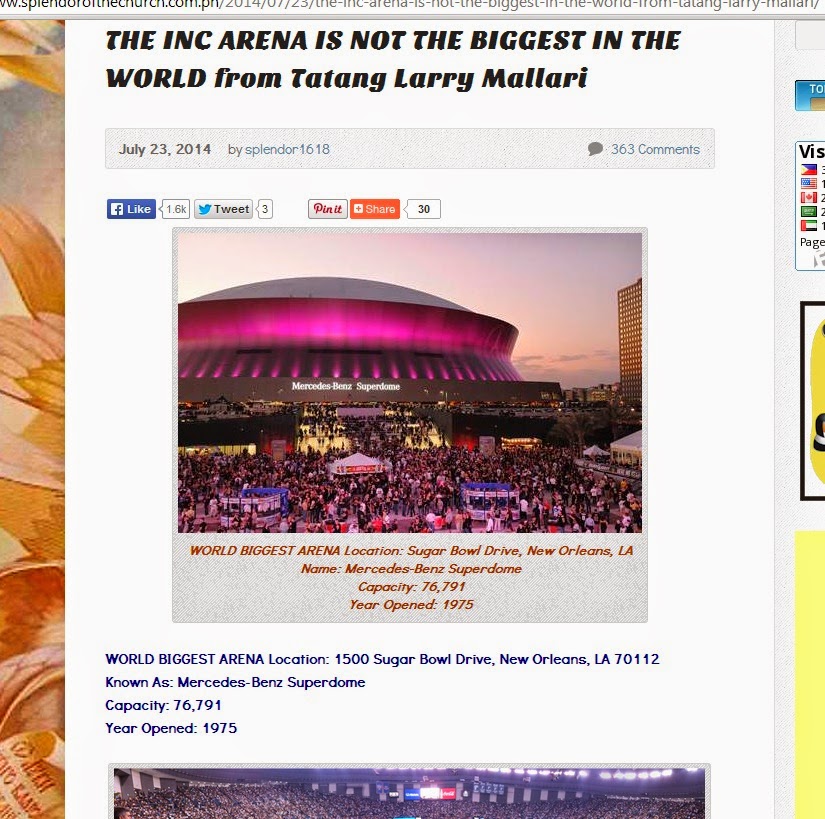
              Kelan pa naging ARENA ang STADIUM? Kitang kita naman namin na ang Texas Cowboy Stadium ay STADIUM. Napasubo lang talaga ang mga CFD sa atakeng yan kaya pinandigan na lang nila kahit alam nilang mali.


Mercedes-Benz Superdome-It is the third STADIUM that has naming rights from Mercedes-Benz (wikipedia)

        Not the biggest kung ikukumpara mo sa STADIUM(superdome pa nga). At sa sobrang desperado ng mga CFD nato ay in-edit pati wikipedia


         Ano nga ba ang pagkakaiba ng ARENA sa STADIUM?

"The basic differences between a stadium and arena are simple. A stadium is considered an outdoor location that can hold a large crowd for a specific event. An arena, by contrast, is an enclosed facility, usually smaller than a stadium, which is used for indoor events."
-SOURCE: http://www.theantiquesgazette.com/editorial/information_to_use/article_fbfb257c-1125-11e3-b0ab-0019bb2963f4.html

          To make it simple, stadium=football at arena=basketball. Tinawag din itong DOMED-ARENA dahil sa dome ang SHAPE ng ROOF. At dahil sa pagka-butata nila, hindi pa din nawala ang pagkabitter o inggit nila kaya ito naman ang kanilang ginawang kalokohan:


            Pagan practice daw ang pagpapagawa ng ARENA. Ang ibig ba nitong sabihin ay nagkaroon din kayo ng PAGANONG ARENA?(sorry,kulang sa research si shaolin juice)Tingnan sa ibaba:
Luna Park is an 8,280-seat arena,[1] located on the corner of Corrientes and Bouchard Avenues, in the barrio of San Nicolás, east Buenos Aires city and near Puerto Madero.
".....has become property of the Catholic Church."

         At ibig bang sabihin ay nagmimisa ang inyong papa at cardinal sa paganong stadium(dahil sabi nyo stadium equals arena)


"Cardinal Francis Spellman (1957), Pope Paul VI (1965), Pope John Paul II (1969 as a cardinal, 1979 as pope), and Pope Benedict XVI (2008) all celebrated Mass at the ballpark, along with numerous clergy and lay Catholics."


           At sa huli, kasama ba ito sa aral nyong katoliko na ang arena ay stadium kaya kailangang nyo itong i-point out?o dala lang ito ng inyong masidhing pagkainggit sa INC?

INC VS RCC DEBATE 11 JULY 2014

           May reaksyon ang mga Catholic Faith Defenders sa "self-congratulatory message" DAW ng INC. Tingnan natin ang larawan sa baba:(mula sa blog ni Mr. Marwil Llasos, natalong kandidato sa pagka-senador)


             Tingnan naman natin ang mga post ng mga CFD "as soon as the debate was finished" Tingnan sa baba:


        Napaka-ipokrito hindi po ba? At napanood nyo ba ang debate? Pansinin ninyo ang madalas na sabihin ni CFD/RDM general alvin gitamondoc na "you fail mr. ventilacion". Panoorin sa baba:


           Sa naganap na debateng yan,bukod sa hindi mo na maintidinhan ang mga sinasabi ni alvin gitamondoc ay puro pa siya "objection" "out of topic next question" . Hindi ata talaga siya marunong makipagdebate. Sa debate kasi may mga "premises" na magpapatunay sa "pinatutunayan". Halimbawa:

"Si Ka Felix Manalo ay sugo ng Diyos"

ang mga premises:
sapagkat hindi siya nagtuturo ng aral ng demonyo
sapagkat sa kanya natupad ang hula
sapagkat pinakilala nya ang isang tunay na Diyos(hindi trinity)
at marami pang iba


            Hindi mo maaring sabihing "out of the topic" yan sapagkat yan ang mga katunayan. Ang kailangan mong gawin ay i-oppose mo yan (hindi puro ka "objection"). Kaya ang ibang CFD ay sila na ang nagdedepensa sa topic ni alvin gitamondoc dahil isang malaking kahihiyan ang ginawa nya sa debate at hindi nila ito matanggap. Pansinin nyo yan mga readers.

KATOLIKO KONTRA BIBLIYA

1. Calling the Priests "Father" is forbidden
FACT: Catholics are taught to call their priest, "Father", as a religious title of respect. Christians in the first century never called their leaders, "father". This first happened hundreds of years later.
Click to View
Question #1: Does Jesus approve of calling the leaders of the church, "Father"?
Answer: Matthew 23:9 
"Do not call anyone on earth your father; for One is your Father, He who is in heaven. Matthew 23:9
2. Praying repetitive words using Rosary beads is forbidden.
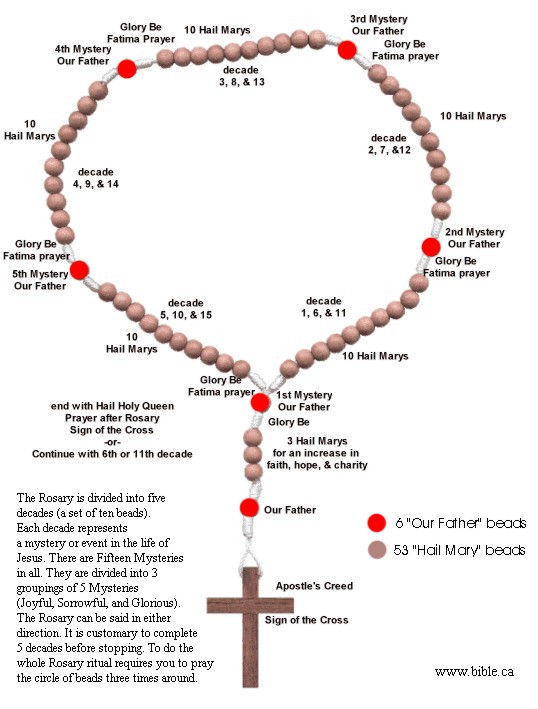
FACT: Catholics pray repetitive words with Rosary Beads that were first invented in 1090 AD, by "Peter the Hermit" and made popular by St. Dominic in 1208 AD. Catholics believe that Mary appeared to St. Dominic in 1208 AD, at the church of Prouille and revealed the Rosary Beads to him. From this time, Catholics prayed 15 sets of 10 consecutive "hail Marys" in a row (150 times), in the Rosary. However, in 2003 AD, Pope John Paul added a new set of Mysteries, so now it is 20 sets of 10 "Hail Marys", (200 times in the Rosary, in total.) Catholics will vainly appeal to Psalm 136 that alternates the same phrase 26 times with 26 different blessings God gives us. It is not 26 in a row as with the rosary! This is also a song, not a prayer. Revelation 4:8 has "angels singing" not "men praying".
Click to View
Click on photo for high resolution
Historical note: Roman Catholics borrowed the idea of praying with beads from the pagan religions who were already using them hundreds of years before: In 456 AD, Hindus are thought to have introduced the concept of praying with beads to the world. The earliest reference to a rosary (boberkhas) is in their "Jain Canon" (456 AD) These boberkhas had various numbers of beads 6,9,12,18,36 (any sub-multiple of 108) Islam (610 AD) uses a rosary of 99 beads, one for each of the names of God. Buddhists have 108 prayer beads on the string. The Rosary is of pagan origin and no Christian prior to 1000 AD used beads to pray.
Question #1: Did Jesus forbid repetitive prayer using Rosary Beads?
Answer: Matthew 6:7 
"And when you are praying, do not use meaningless repetition as the Gentiles do, for they suppose that they will be heard for their many words. Matthew 6:7

3. Virgin Mary
FACT: Roman Catholics are taught the virgin Mary never had sex after Jesus was born and that Jesus had no brothers and sisters. The Pope teaches that Mary is the mediator between God and man. Catholics also engage in more praising of Mary than Jesus Christ himself and actually pray to her to have their prayers answered. Rosary Beads graphically represent how Roman Catholics heap 10 times more praise upon Mary than God himself. Of the 59 total beads of the Rosary, 53 beads are "Hail Marys", but only 6 beads are "Our Father". The Rosary most often ends with a "Hail, Holy Queen" prayer to Mary, not God.
Click to View
Question #1: Did Jesus have brothers and sisters from the womb of Mary?
Answer: Matthew 13:55-56
"Is not this the carpenter's son? Is not His mother called Mary, and His brothers, James and Joseph and Simon and Judas? "And His sisters, are they not all with us? Where then did this man get all these things?" Matthew 13:55-56
Click to ViewClick here for proof Mary had other children.

Question #2: Did Joseph begin normal sexual relations with his wife after Jesus was born?
Answer: Matthew 1:24-25 
"And Joseph awoke from his sleep and did as the angel of the Lord commanded him, and took Mary as his wife, but kept her a virgin until she gave birth to a Son; and he called His name Jesus." Matthew 1:24-25
Click to ViewClick here for proof Mary had other children.
Question #3: The Bible says there is only one mediator between God and man. Is mary that one mediator?
Answer: 1 Timothy 2:5 
"For there is one God, and one mediator also between God and men, the man Christ Jesus." 1 Timothy 2:5
Question #4: Catholics engage in endless praise of Mary. When a woman praised Jesus' mother to his face, did Jesus commend encourage this woman to continue praising Mary?
Answer: Luke 11:27-28
"While Jesus was saying these things, one of the women in the crowd raised her voice and said to Him, "Blessed is the womb that bore You and the breasts at which You nursed." But He said, "On the contrary, blessed are those who hear the word of God and observe it."" Luke 11:27-28

4. Every Christian drinks of the communion cup
FACT: From 1200-1970 AD, Roman Catholics laity were forbidden to drink the blood. This is known as communion under one kind, or communion of one species. During this time, Roman Catholics are permitted to eat the bread (body) of the Lord's Supper, they are generally not allowed to drink the wine (blood) of the Lord's Supper, as any Catholic knows from his own experience from attending Mass. (Except on rare special occasions.) The laity (the people in the pews) are withheld the cup of the Lord and it is usually reserved for church leaders only. Yes there are denominations within the Roman Catholic "communion" where some RC sects actually offer the juice, but most Mass attending Catholics know they rarely drink the cup of wine.
Historical note: Two early popes condemned withholding the cup, (Pope Leo I [died 461 AD] and Pope Gelasius [died 496 Ad]; but in the 12th century the practice was begun, and formally approved by the Catholic Council of Constance in 1415 AD. So for the first 1000 years, the Catholics in the Pews drink the cup, then the Pope changed this apostolic tradition. Under the reforms of Vatican II, the laity were once again permitted to have "communion under both kinds/species". Today many Roman Catholics are unaware that for almost 900 years, the average members were forbidden to drink the blood. While Catholics have restored their practices back to the original first century tradition which they call, "communion under both kinds", it illustrates the ever shifting and changing doctrinal evolution that is present in the Roman Catholic church.
Question #1: Did Christ and the apostle Paul command that every Christian should drink of the communion cup?
Answer: Matthew 26:26-28; 1 Corinthians 11:23-28 
To the disciples: "Drink from it, all of you" Matthew 26:27
To the whole church in Corinth: "in so doing he is to eat of the bread and drink of the cup." 1 Corinthians 11:28
"While they were eating, Jesus took some bread, and after a blessing, He broke it and gave it to the disciples, and said, "Take, eat; this is My body." And when He had taken a cup and given thanks, He gave it to them, saying, "Drink from it, all of you; for this is My blood of the covenant, which is poured out for many for forgiveness of sins." Matthew 26:26-28
"For I received from the Lord that which I also delivered to you, that the Lord Jesus in the night in which He was betrayed took bread; and when He had given thanks, He broke it and said, "This is My body, which is for you; do this in remembrance of Me." In the same way He took the cup also after supper, saying, "This cup is the new covenant in My blood; do this, as often as you drink it, in remembrance of Me." For as often as you eat this bread and drink the cup, you proclaim the Lord's death until He comes. Thereforewhoever eats the bread or drinks the cup of the Lord in an unworthy manner, shall be guilty of the body and the blood of the Lord. But a man must examine himself, and in so doing he is to eat of the bread and drink of the cup." 1 Corinthians 11:23-28
Click to View


5. All Christians are saints
FACT: The Pope says only very special dead Catholic people qualify to be called "saints". For example, Pope John Paul II could not make Mother Teresa a saint (official canonization) until after she was dead. The average Catholic in the pew is never called a "saint" dead or alive! In fact if a pew dwelling Catholic started calling himself a "saint", he would be rebuked by the parish priest!
Question #1: Was every living Christian in the church in Corinth called a saint?
Answer: 1 Corinthians 1:2 
"To the church of God which is at Corinth, to those who have been sanctified in Christ Jesus, saints by calling, with all who in every place call on the name of our Lord Jesus Christ, their Lord and ours" 1 Corinthians 1:2
Question #2: Did Paul write the book of Ephesians to dead saints?
Answer: Ephesians 1:1 
"Paul, an apostle of Christ Jesus by the will of God, To the saints who are at Ephesus and who are faithful in Christ Jesus" Ephesians 1:1
Question #3: Was the average Christian in the church at Philippi called a saint, in distinction to bishops and deacons?
Answer: Philippians 1:1 
"Paul and Timothy, bond-servants of Christ Jesus, To all the saints in Christ Jesus who are in Philippi, including the overseers and deacons" Philippians 1:1
Question #4: Was every Christian living in Rome called to be a saint?
Answer: Romans 1:7
"to all who are beloved of God in Rome, called as saints: Grace to you and peace from God our Father and the Lord Jesus Christ." Romans 1:7
6. All Christians are priests
FACT: The Pope decided to reserve the title of "priest" to worn by church leaders only. The average pew dwelling Catholic never refer to themselves as "priests". In fact if a lay Catholic started calling himself a "priest", he would be rebuked by "the parish Priest"!
Question #1: Did Jesus make all Christians to be priests, including the average member in the pew?
Answer: 1 Peter 2:5,9; Revelation 1:6; 5:10 
"you (all Christians) also, as living stones, are being built up as a spiritual house for a holy priesthood, to offer up spiritual sacrifices acceptable to God through Jesus Christ. " 1 Peter 2:5
"But you (all Christians) are a chosen race, a royal priesthood, a holy nation, a people for God's own possession, so that you may proclaim the excellencies of Him who has called you out of darkness into His marvelous light; " 1 Peter 2:9
"Jesus has made us (all Christians) to be a kingdom, priests to His God and Father—to Him be the glory and the dominion forever and ever. Amen." Revelation 1:6
"You have made them (all Christians) to be a kingdom and priests to our God; and they will reign upon the earth." Revelation 5:10
7. Bishops must be Married.
FACT: In 1079 AD celibacy was first enforced for priests and bishops by Pope Gregory VII. Before this time, they were permitted to marry.
Question #1: Does the Bible teach that a bishop (overseer) must be married AND ALSO have children as one of the conditions of being qualified to be a bishop?
Answer: 1 Timothy 3:2-5 
"A bishop, then, must be above reproach, the husband of one wife, temperate, prudent, respectable, hospitable, able to teach, not addicted to wine or pugnacious, but gentle, peaceable, free from the love of money. He must be one who manages his own household well, keeping his children under control with all dignity (but if a man does not know how to manage his own household, how will he take care of the church of God?)" 1 Timothy 3:2-5
Question #2: In the very next chapter of the Bible after bishops are told they must be married with children, does the Holy Spirit warn that "forbidding to marry" is a "doctrine of demons"?
Answer: 1 Timothy 4:1-3 
"But the Holy Spirit explicitly says that in later times some will fall away from the faith, paying attention to deceitful spirits and doctrines of demons, by means of the hypocrisy of liars seared in their own conscience as with a branding iron, men who forbid marriage and advocate abstaining from foods which God has created to be gratefully shared in by those who believe and know the truth." 1 Timothy 4:1-3
8. Peter was married
FACT: Most Catholics believe that Apostle Peter was the first Pope and was not married. As one Roman Catholic leader said, "if Peter had a wife when he first met Jesus, he got rid of her quick!"
Question #1: Did Peter have a wife?
Answer: Mark 1:30 
"Now Simon's mother-in-law was lying sick with a fever; and immediately they spoke to Jesus about her." Mark 1:30
Question #2: Did Paul say all the apostles including Peter had a right to be married?
Answer: 1 Corinthians 9:5 
"Do we not have a right to take along a believing wife, even as the rest of the apostles and the brothers of the Lord and Cephas?" 1 Corinthians 9:5
9. Latin Mass forbidden
FACT: For over 1000 years, the Roman Catholic church often conducts their mass services entirely in the Latin language, when no one sitting in the pews understands the Latin language. Most Roman Catholics who have sat through such a Latin Mass service have wondered what is going on. It was not until 1965 AD that the Pope finally understood 1 Cor 14:19 and allowed masses to conducted in the same vernacular language of the local people. (English in North America)
Question #1: Is Latin Mass forbidden in the Bible when no one in the pews understands Latin?
Answer: 1 Corinthians 14:19 
"in the church I desire to speak five words with my mind so that I may instruct others also, rather than ten thousand words in an unknown tongue." 1 Corinthians 14:19
10. Observance of special days condemned
FACT: The Roman Catholic church has invented an entire yearly calendar of non Biblical holy Days like Lent, Easter, Christmas.
Click to View
Historical note: No one prior to 335 AD celebrated the birthday of Jesus. The word "Christmas" (Christ + Mass) was first used in 1038 AD. Before 335 AD, the pagan cult of Mithra, the Iranian "god of light", had long celebrated December 25 as Mithra's birthday. December 21, being the winter solace, marked the beginning of days with increasing amount of light, hence December 25 celebrated Mithra's triumph over darkness. Because the pagan festival that celebrated Mithra's birthday was so popular, the Roman Catholic church adopted the day, but changed the meaning from the birthday of Mithra, the "god of light", to Christ's birthday, God the son, "light of the world". The old meaning of December 25 was connected with Mithra's triumph over physical darkness. The new meaning celebrated Jesus triumph over spiritual darkness. Eventually Christmas became dominant, the Mithra cult went extinct and today this origin is not widely known among Roman Catholics. None of the apostles or the early church celebrated the birthday of Jesus.
Question #1: Did the early Christians celebrate Christmas, Lent and Easter?
Answer: Galatians 4:10-11
"You observe days and months and seasons and years. I fear for you, that perhaps I have labored over you in vain." Galatians 4:10-11
Question #2: Are Christians told to remember the Lord's Death every Sunday?
Answer: Acts 20:7 
"On the first day of the week (Sunday), when we were gathered together to break bread, Paul began talking to them, intending to leave the next day, and he prolonged his message until midnight." Acts 20:7
11. Worshipping idols, icons and images violates the 2nd commandment.
FACT: Catholics regularly bow down to idols, icons and images of Jesus, Mary and the apostles, kissing the feet of the statues and praying to them. Now Catholics get very upset when you accuse them of worshipping Mary. They deny they are worshipping Mary with loud illogical and irrational protests. What these need to understand, is that the Bible teaches that WE ONLY PRAY TO DEITY and Christians considers it paganism and polytheism to pray to anyone EXCEPT the Father, Son or Holy Spirit. So while Catholics pray to Mary, they fail to comprehend that only deity is to be prayed to, and this is the underlying reason why non-Catholics correctly lay the charge they worship Mary AND ALL THE SAINT, they pray to. The Bible clearly teaches that all dead humans, though conscious in the spirit world, are unable to know anything, much less hear prayers addressed to them. Bowing down to icons and kissing them etc. so closely resemble idol worship it is actually shocking that any Roman Catholic would attempt to defend the practice. But again, they simply do the practice but deny it is worship. To illustrate the point, Muslim deny they are worshipping the moon god as their "Allah" as moon worship is even condemned in the Koran. But the fact of history is that Muhammad rid the Kaaba in Mecca of the 365 gods inside the cubical building, but retained the one on the roof known as the moon god "Hubal". Muhammad simply took the moon god from the roof, denied it was the moon god and called Hubal "Allah". The historical vestage of this origin is confirmed in that every mosque in the world has a crescent moon on the roof… just like the original Hubal moon god on the roof of the Kaaba. Muslims get mad when you point out that Allah is really the moon god and Catholics get mad when you point out they are worshipping the Mary and the saints when they pray to them. When a child stands in the middle of a room and puts his hand over his eyes and says, "you can't see me", that doesn't mean they are invisible, except in the mind of the child. Roman Catholics put their hands over their eyes and say, "We do no worship idols and we do not consider praying to Mary and act of worship". Saying so doesn't make it so. Roman Catholic apologists who harshly criticize protestants who accuse them of worshipping idols and Mary need to take a close look in the mirror and be honest with reality. At the very least, they could tone down their ranting against protestants "misrepresenting Catholic faith" with a bit of self-reflection and a good history lesson.
Historical note: The Pope deleted the 2nd of the 10 commandments so they could use statues & images in worship. They split the 10th commandment on coveting into two commandments so they could still have 10 in number. Don't believe this? Look at the list of 10 commandments published by the Roman Catholic church! The issue here is not how the Ten Commandments are numbered, rather the issue is that most published lists of the 10 commandments do not include the words, "you shall not for yourself an idol". Open your Catholic Bible and look for yourself!
Question #1: Does the 2nd commandment approve of bowing down and kissing idols?
Answer: Exodus 20:4 
"You shall not make for yourself an idol, or any likeness of what is in heaven above or on the earth beneath or in the water under the earth. You shall not worship them or serve them." Exodus 20:4-5

12. Baptism is full immersion in water, not sprinkling.
FACT: The Catholic church baptizes babies by sprinkling a little water on them.
Historical note: Greek work for baptism literally means immersion. There are separate words in Greek for sprinkling, pouring and immersion. Only the Greek word for immersion is ever used for Baptism in the Bible. The first recorded case of sprinkling was in 257 AD to someone on a sick-bed. It was then an exception to the rule and brought about fierce opposition from the whole church. Not until 757 AD did the church accept sprinkling in such sick-bed cases of necessity. It wasn't until 1311 AD, when the Catholic council of Ravenna, declared that sprinkling was and acceptable substitute for immersion and from that time forward sprinkling replaced immersion in the Roman Catholic church. The Orthodox church refused sprinkling and still immerses to this day.
Click to View
Question #1: Was Jesus baptized by full immersion in the Jordan River?
Answer: Matthew 3:16 
"After being baptized, Jesus came up immediately from the water; and behold, the heavens were opened, and he saw the Spirit of God descending as a dove and lighting on Him" Matthew 3:16
Question #2: When Philip baptized the Eunuch, did both of them go into the water?
Answer: Acts 8:38-39 
"And he ordered the chariot to stop; and they both went down into the water, Philip as well as the eunuch, and he baptized him. When they came up out of the water, the Spirit of the Lord snatched Philip away." Acts 8:38-39
Question #3: Can babies be baptized since they do not first believe?
Answer: Mark 16:16; Acts 8:36-37 
"He who has believed and has been baptized shall be saved; but he who has disbelieved shall be condemned. Mark 16:16
"As they went along the road they came to some water; and the eunuch said, "Look! Water! What prevents me from being baptized?" And Philip said, "If you believe with all your heart, you may." Acts 8:36-37
Question #4: Can babies be baptized since they do not first repent?
Answer: Acts 2:38 
"Brethren, what must we do?" Peter said to them, "Repent, and each of you be baptized in the name of Jesus Christ for the forgiveness of your sins; and you will receive the gift of the Holy Spirit. Acts 2:37-38

13. Original sin is false doctrine
FACT: Catholics say that infants inherit their parent's sin at conception and are therefore spiritually condemned and totally wicked.
Question #1: Is the doctrine of inherited original sin found in the Bible?
Answer: Ezekiel 18:20 
"The person who sins will die. The son will not bear the punishment for the father's iniquity, nor will the father bear the punishment for the son's iniquity; the righteousness of the righteous will be upon himself, and the wickedness of the wicked will be upon himself." Ezekiel 18:20
Question #2: Did Jesus say little children are better models of purity and conduct than adults?
Answer: Matthew 18:2-3 
"And He called a child to Himself and set him before them, and said, "Truly I say to you, unless you are converted and become like children, you will not enter the kingdom of heaven." Matthew 18:2-3
14. Every Christian can understand the Bible by merely read it.
FACT: Catholics are taught that only the priests can understand the Bible and the common man in the pew cannot understand the Bible without the priests help.
Click to View
Question #1: Do the scriptures say that when anyone reads the Bible, they can understand for themselves?
Answer: Ephesians 3:4 
"By referring to this, when you read you can understand my insight into the mystery of Christ" Ephesians 3:4
15. Catholics are unwilling to defend their faith
FACT: When Roman Catholics are challenged from the Bible to defend their faith, they are unwilling or unable to defend what they believe and say the priest has the answer and never search the truth out for themselves. Priests and Bishops never get permission to have open public Bible discussions with honest Bible students like ourselves. Imagine a local parish priest publicly defending infant baptism against a Christian who taught the practice contradicted the Bible! It never happens! Forget what the Bible says, just trust the priest!
Question #1: Should a Christian be unable to defend what they believe from the Bible without the help of priests?
Answer: 1 Peter 3:15 
"sanctify Christ as Lord in your hearts, always being ready to make a defense to everyone who asks you to give an account for the hope that is in you, yet with gentleness and reverence" 1 Peter 3:15
16. Human tradition and man made doctrine is apostasy
FACT: The Pope teaches that he can change what is in the Bible if he wants.
Question #1: Did Jesus say it was OK for man to change what the word of God teaches for man-made Catholic doctrine?
Answer: Mark 7:7-9 
"'But in vain do they worship Me, Teaching as doctrines the precepts of men.' "Neglecting the commandment of God, you hold to the tradition of men." He was also saying to them, "You are experts at setting aside the commandment of God in order to keep your tradition." Mark 7:7-9
Conclusion: How the Catholic church views the Bible
Below are the kinds of replies you can expect from a Roman Catholic priest if you ask him about the contents of this Bible study.
  1. Yes I know Matthew 23:9, seems to condemn calling me "Father", but you are not able to understand the Bible like I do.
  2. Yes I know is appears like Jesus condemned the repetitive prayer of the Rosary beads in Matthew 6:7, but Mary appeared to St. Dominic in 1208 AD and revealed to him the Rosary Beads herself!
  3. Yes Matthew 13:55-56 seems to indicate that Jesus had brothers and sisters, but these were the children of Joseph from a previous marriage or just cousins.
  4. Yes, I agree that 1 Timothy 2:5 sounds like Jesus is the only mediator between god and man, but the Pope decided she was indeed also a mediator between God and man
Click to View
Summary:
  1. Yes Christ and Paul did command every Christian to drink of the communion cup in Matthew 26:26-28; 1 Corinthians 11:23-28. And Yes I know that two early popes condemned withholding the cup, (Pope Leo I [died 461 AD] and Pope Gelasius [died 496 Ad]; but in the 12th century the practice was begun, and formally approved by the Catholic Council of Constance in 1415 AD. Yes I know that in 1970 the pope restored the cup to the laity.
  2. Was every living Christian in the church in Corinth called a saint?
  3. Yes I know that in the Bible (1 Corinthians 1:2; Ephesians 1:1; Philippians 1:1; Romans 1:7) every Christian was a saint and every saint was a Christian. Yes I agree, the Bible uses the word saint as interchangeably synonymous with being a Christian, but the Roman Catholic church has the power to change the Bible.
  4. Yes I know that in the apostolic church (1 Peter 2:5,9; Revelation 1:6; 5:10), every Christian was a priest and the two terms are used interchangeably synonymous with being a Christian, but the Roman Catholic church decided that only leaders should be called priests.
  5. Yes I know that the Bible appears to teach that 1 Timothy 3:2-5 bishops must be married with believing children, but you can't even understand the Bible anyway, why do you ask? Just trust me because only Catholic priests can understand the Bible.
  6. Yes I have read 1 Timothy 4:1-3, and is seems to condemn forbidding the marriage of Catholic priests, but the Pope decided that unmarried men are more holy than married men.
  7. Yes I know that Mark 1:30; 1 Corinthians 9:5 say that Peter had a wife 23 years after Christ died on the cross (53 AD), but Pope Gregory VII decided in 1079 AD from that time onward, that church leaders cannot marry.
  8. Yes I know that sitting through a Latin Mass service can be very boring for many Catholics in the pews. And yes I know that 1 Corinthians 14:19 condemns conducting a church service in a language the average member does not understand, but the Pope decided that Latin sounds real holy and has both historical and mystical qualities.
  9. Yes I know the early church did not begin to celebrate Christmas until the 4th century. And yes I know that Galatians 4:10-11 condemns the keeping of such holy days not found in the Bible, but the church at Rome needed a way to convert the pagan worshippers of Mithra, the god of light... and it worked!
  10. Yes I know that Acts 20:7 commands Christians to have weekly communion services and that the early church did not celebrate Easter as is done today, but having a yearly communion service was something later church leaders wanted to add to worship.
  11. Yes I know that the Roman Catholic church deleted the 2nd commandment (Exodus 20:4) in order to hid from the masses God's condemnation of bowing down and kissing images of Mary and Peter, but Mary revealed herself to us in a vision.
  12. Yes I know that Jesus was baptized by full immersion in the Jordan River (Matthew 3:16), and that sprinkling was not officially approved until 1311 AD, but it sure is more convenient.
  13. Yes I know that babies have no faith and cannot repent, and are therefor not really valid candidates for baptism (Mark 16:16; Acts 8:36-37; Acts 2:38). But the Pope invented the idea of where the faith and repentance that the infant lacks, is exchanged for the faith and repentance of a "God Parent". Yes I know none of this is in the Bible, but the Pope is the "holy see" and he must know what he is doing!
  14. Yes I know Ezekiel 18:20 proves the doctrine of total hereditary depravity (inherited original sin) contradicts the Bible, but you cannot understand the Bible anyway, only the priest can correctly interpret it.
  15. Yes I know that Matthew 18:2-3 teaches that children are better models of purity and conduct than adults, but the Pope teaches that infants are wicked defiled sinners condemned to hell until a Catholic priest baptizes them and removes the curse of original sin.
  16. Yes I know Ephesians 3:4 plainly seems to say that when you read the Bible by yourself, you can have the same insight that the apostle Paul had into spiritual things, but we Catholic priests cannot teach all our false doctrines that contradict the Bible unless we convince you that you can't understand the Bible unless the priest helps you.
  17. Yes I know that 1 Peter 3:15 teaches every Christian should be able to defend from the Bible what they believe, but isn't that what us Roman Catholic priests are supposed to do? Do you want to put us out of job and rob us of all our power and control?
  18. Yes I know that human traditions that contradict the Bible are condemned in Mark 7:7-9, but all the doctrines that contradict the Bible which the Pope through up were revealed to him directly by Christ and therefore, although they contradict the Bible, they are divinely approved by Christ himself.
  19. You really shouldn't be reading the Bible anyway. And while we are talking about it, what else do you want me to teach you about what the Bible says?

Is the Roman Catholic church the church you read about in the Bible?

Source: http://www.bible.ca/cath-overview-false-teaching.htm